
Do you need a big bore to hunt big boar?
by: Craig Gillock
It’s the time of year when, if you’re a hunter, you are trying to decide how you want to spend the “off-season.” You could focus on running trail cameras and putting in food plots. Perhaps your intent is to do a little running and gunning, chasing thunder chickens on an eastern ridge or through a thick stand of west Texas mesquite. Maybe you’ve given some thought to taking a trip across the Equator in search of some southern hemisphere beastie. Or maybe you just want to kick back and do a little fishing. All of these are good options and can help fill the time until late summer rolls around and the magic that is hunting season starts anew. For my money, however, the best springtime adventure is stalking the dark, thick-haired bruins of the western United States and Canada.
When the subject of bear hunting comes up, one of the most frequent questions I get asked is, “What do you use to hunt a bear?” I usually flash my inquirer a grin and tick off the calibers I’ve used: 7mm RUM, 7mm Rem Mag, 338 Win Mag, 270 Win, 300 WSM, and 6.5 PRC. If I feel like getting a good “gasp” reaction, I tell them that I’ve also taken multiple bears with a bow and arrow. A majority of people still think all bears are the size of the behemoths found walking the shorelines of coastal Alaska or the Arctic tundra. When people learn that most black bears are under 400lbs and only a few feet tall on all fours, they’re shocked. Obviously, there are exceptions to this. Every year there are at least one or two Pennsylvania hunters that harvest bears that top out at over seven feet and 600lbs. And Vancouver Island is well-known for the above average size of its bears. But for the most part, the assumed size of Ursus americanus (American black bear) is all fluffy hair and Disney movies.
So, how do you know what caliber to use when going bear hunting? Do you grab any old magnum out of the safe and figure that will get the job done? Of course not! As with any hunt you prepare for, there are considerations that should be taken into account when selecting your rifle and caliber.
The first thing you need to understand is bear anatomy. Any book or magazine article about bear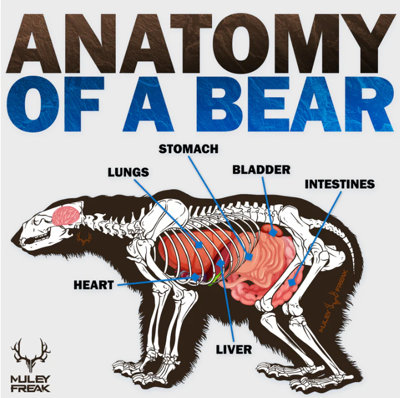 hunting will tell you that, while there are
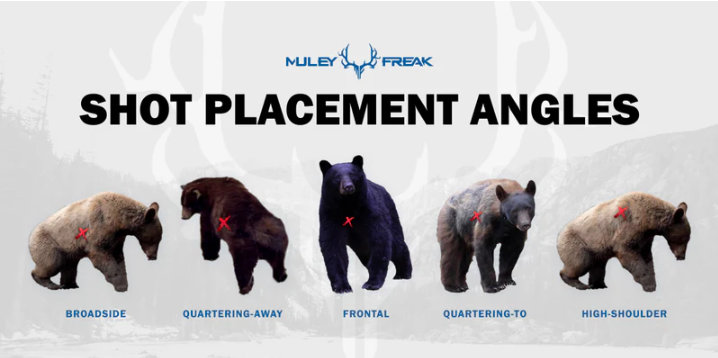
  similarities between the location of organs in bears and organs in other common big game animals such as deer or elk, there are subtle differences that require you to adjust your aim. A bear’s heart for example sits behind the shoulder, like most other North American big game animals, but it sits a little lower in the chest. The lungs on a bear also sit lower than other animals and they are not protected by the scapula. Their lungs are also smaller than deer or elk’s because they are built for short, quick bursts of speed versus prolonged flight from predators. The team over at Muley Freak has put together a couple of really good visuals showing this and I feel it is beneficial to include them in this article.
You also need to understand that bears have a very tough hide, much tougher than a deer, and that hide is then covered with a mat of thick, energy sapping hair. Under the hide, your bullet needs to contend with layers of fat and dense bones that do an excellent job at stopping projectiles. You will need to use a caliber that has bullet offerings that are proven penetrators and create devastating wound channels. Getting a complete pass-through is the best scenario because the animal is less likely to develop a clot and stop bleeding. Pass-throughs also lend themselves to quicker, cleaner kills. The last thing you want to be doing is trailing a poorly hit bear in the dark. Look at the Sierra Tipped Game Kings or the Barnes TTSX or Barnes LRX. I’ve taken multiple bears with my 7mm RUM loaded with a Barnes 145gr LRX. It is a combination which has never failed me. In fact, I used that same combination to take my moose in British Columbia and my best ever muley, in the Livingstone Range in Alberta.
Where you’re hunting and what type of hunting you will be doing should be thought about when selecting your rig. If your hunt is a spot and stalk in the mountains of Idaho or the dense forests of eastern Washington, you would probably want a caliber like 6.5 PRC loaded with a heavy 145gr bullet that can fit in a short action rifle. This would let you cut your overall weight and choose a more compact, maneuverable rifle that is easier to carry or fit in a pack. If you’re glassing across open tundra somewhere like the Northwest Territories or Alaska and there is the possibility of needing knockdown power for a long shot or because a grizzly invited itself to the party a 28 Nosler or 340 Weatherby Mag might be more your style. And, if you’re sitting in a treestand hunting color-phase bears in Alberta, your shot is likely to be within 50 yards, so maybe you want to use your granddad’s trusty old 308 Win or 30-06 Sprg, not that these calibers aren’t capable of taking game at distances well over 50 yards. The point is you have a lot of options; just weigh those options against what type of hunting you plan on doing.
Two other pieces of information that are crucial to caliber selection are what species of bear you are hunting and is there a caliber size requirement. Ninety-nine percent of the time, when someone says they are going spring bear hunting they’re chasing black bears. But, for those hunters who prefer a bigger, more dangerous pursuit, there are still opportunities to hunt grizzlies in Alaska and the Yukon. There is currently a ban on grizzly hunting in British Columbia, but groups such as the B.C. Wildlife Federation are advocating its reinstatement, claiming that grizzly hunting is a viable way to manage the species and help reduce human-bear interactions.
If you are one of the hunters who has chosen to pursue the black bear’s bigger cousin, you will want a caliber that is capable of putting one of these giants down, quickly. As someone who has unexpectedly come face to face with two of these bears inside of ten yards, trust me on this. I know there will undoubtedly be critics who will say that you can kill a grizzly with a 6.5 Creedmoor or 270 Win or some other smaller non-magnum caliber. And they’re correct. You can definitely do that. You can also race a Ferrari on a Schwinn. But should you? I can tell you, if I’m hunting grizzly or brown bears, I’ll be carrying a 340 Weatherby Mag, 338 Win Mag, 33 Nosler, or a very similar caliber. This can be where caliber size requirements come into play.
A few years ago, my father and I were planning a grizzly hunt in Alaska. The hunt ended up not happening, but several of the outfitters we spoke to about it required that you used at least a 300 RUM or bigger on the hunt.
So, what caliber should you use to go bear hunting? That depends on what type of hunt you plan and what type of bear you want to harvest. Unless you want to carry one of the big magnums, I don’t feel there is a “one caliber to do it all.” I’ve already said I feel the 340 Weatherby Mag is an excellent choice for grizzly, but I would argue that it is way over-bored for black bears in most situations. Sure, it will take down any black bear you come across, but why deal with the recoil and expense of the ammunition if you don’t need to. Take some time, think about the application you want to use it for, and choose a caliber that makes sense for each individual situation. You’ll have a more enjoyable hunt, and it may just give you the reason you were looking for to buy a new gun!
Good luck! And happy hunting!
By entering this website, you certify that you are 18 years of age or older.